
The year was 2026, and Marcus, a weathered veteran of a thousand deaths across Lordran, Drangleic, and Lothric, found himself staring at the Lands Between’s ever-shifting skyline. Elden Ring had sunk its claws into him back in 2022, and even now, four years later, the release of its massive expansion Shadow of the Erdtree still felt like yesterday. But as he scrolled through yet another forum thread debating whether the DLC’s entrance was “too easy” or “just right,” his mind drifted back to a much darker time—literally. The Artorias of the Abyss DLC for the original Dark Souls. To him, that expansion was the stuff of legends, not because of its incredible boss fights—though Knight Artorias himself was a sublime dance of death—but because simply finding the damn thing was a nightmare wrapped in an enigma.
Back in 2012, Marcus had spent two full evenings banging his head against the wall, utterly clueless about how to access the new content he’d already paid for. The steps were so convoluted they’d become infamous: kill the Hydra in Darkroot Basin, rescue Dusk of Oolacile from a golden crystal golem, summon her, then later, after placing the Lordvessel, acquire the Broken Pendant from a random crystal golem in the Duke’s Archives, and only then get sucked into a portal by a dark hand. If you missed a single link in that chain—say, you forgot to reload the area after the Hydra fight, or you just assumed the golem was another trash mob—you were well and truly stuck. Looking back, Marcus let out a bitter chuckle. “Talk about a wild goose chase,” he muttered. The whole ordeal had been a textbook case of FromSoftware’s cryptic DNA going into overdrive, a move that forced the community to huddle together in forums and wikis like campers around a bonfire. And honestly? For its time, it was kind of magical. But Elden Ring was a different beast entirely.
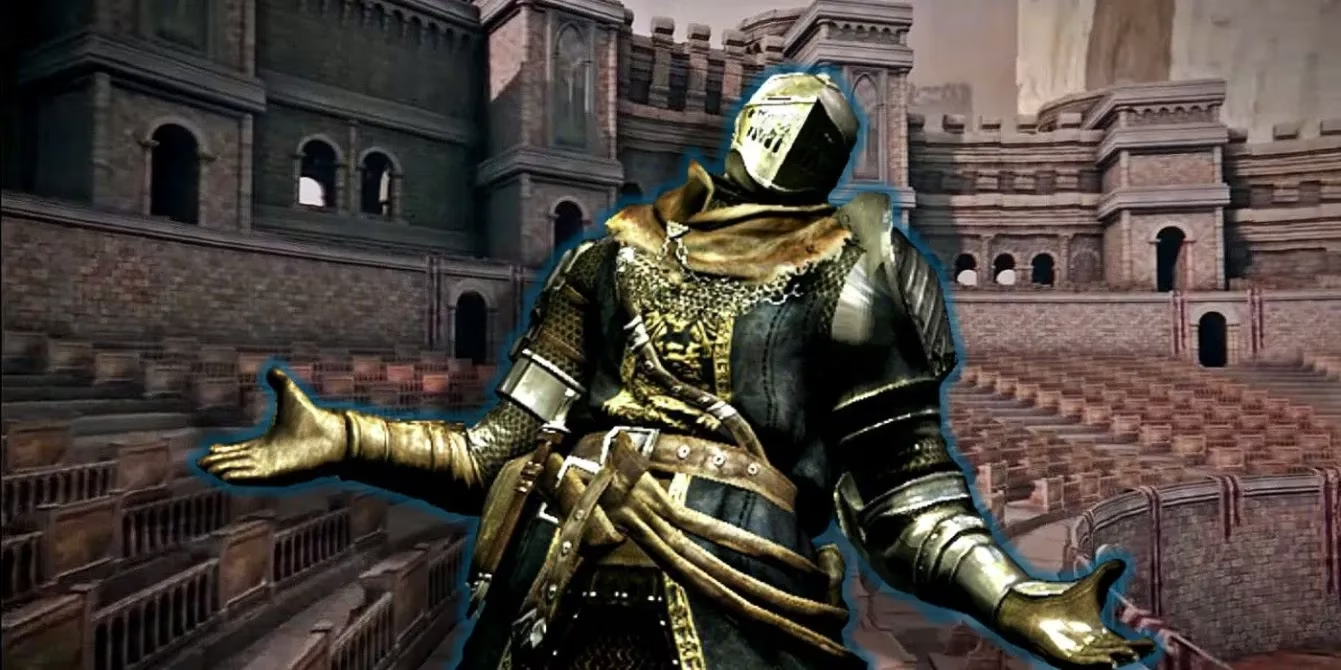
Fast-forward to 2022, and the gaming world was buzzing with speculation about Elden Ring’s future. Articles popped up like mushrooms after a rainstorm, many of them echoing the same fear: would FromSoftware repeat its old DLC mistake? The base game already boasted a colossal map, but some regions—Mountaintops of the Giants, anyone?—felt a little half-baked. Fans were starving for more. The fear was that a potential DLC might be hidden behind some equally absurd sequence of gestures, environmental triggers, and moonlight-dependent NPC spawns. After all, Elden Ring was the magnum opus of Hidetaka Miyazaki, a glorious blender of Dark Souls, Bloodborne, and Sekiro DNA. It was only natural to worry that the team’s taste for obscurity would rear its head again. In a game where entire questlines could collapse because you walked ten feet past an invisible flag, the prospect of locking paid DLC behind a near-impossible riddle felt like a legitimate horror story. Community whispers painted a picture of Tarnished warriors scouring every inch of Liurnia for a hidden door, only to realize they needed to hit an illusory wall with a specific weapon at a specific time of day. The mere thought gave Marcus conniptions.
The core argument back then was simple: Elden Ring’s open-world scale demanded a different approach. In Dark Souls, the interconnected hallways meant you’d eventually stumble upon the pendant if you were thorough. But in the sprawling Lands Between, “thorough” meant riding Torrent for hundreds of hours. If the DLC entrance was tucked away as obscurely as Oolacile’s, the game would effectively kneecap its own community engagement. Sure, the shared struggle of deciphering esoteric clues forged an amazing camaraderie in 2012, but by 2026? Players had lives, jobs, and a dozen other live-service titles breathing down their necks. Making them jump through too many hoops would backfire spectacularly. It’d be like hiding the steak dinner they paid for in a locked box at the bottom of a lake, then tweeting them a riddle about the key. No one had time for that. As one popular YouTuber put it at the time, “You can’t just ‘git gud’ at finding invisible triggers, mate.”
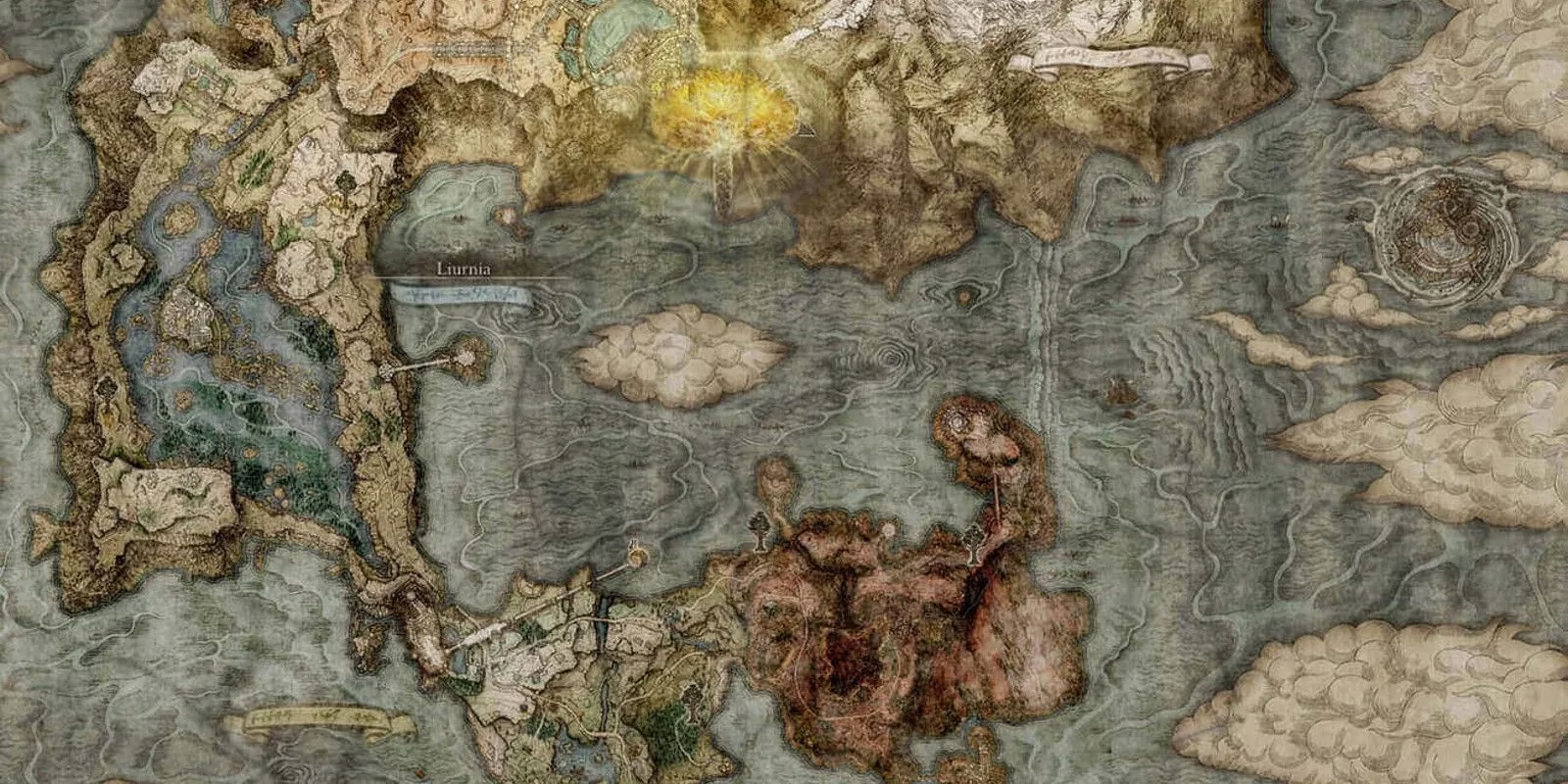
Then June 2024 rolled around, and Shadow of the Erdtree dropped like a meteor—and from the very first hour, Marcus felt a warm wave of relief. The entrance wasn’t tucked behind seven layers of nonsense. Instead, you simply had to have defeated Starscourge Radahn and Mohg, Lord of Blood. That was it. A new figure, Leda, appeared near Mohg’s cocoon, and touching the withered arm transported you straight into the Realm of Shadow. No obscure pendants, no time-sensitive NPC windows, no need to do a specific emote on a specific cliff at dawn while double-wielding torches. It was straightforward yet still rewarded players who had explored the game’s most hidden corners—Mohgwyn Palace was hardly a mainstream tourist destination before the DLC hype. Marcus remembered laughing out loud when he first stepped through. The method was the perfect middle ground: obtuse enough to feel “earned,” but clear enough that you didn't need a PhD in wiki-reading to find it. The game didn’t hold your hand, but it also didn’t tie your shoelaces together and push you down a flight of stairs.
This design philosophy bled into the entire expansion. The Land of Shadow was prominently featured on the new map, a vast, layered continent stitched into the fabric of the lore. Quests intertwined logically with the main path, and while there were still plenty of secrets—that entire Abyssal Woods sequence was a masterclass in tension—nothing felt like an elaborate prank on the player. It was as if FromSoftware had finally embraced a “show, don’t hide” mantra. The team had clearly taken the Artorias of the Abyss criticism to heart, recognizing that community spirit doesn’t have to be forged in frustration. The sheer joy of discovering a new underground river or a legacy dungeon was immense precisely because you weren’t constantly second-guessing whether you were missing the whole damn DLC. It was a breath of fresh air, a real game-changer.
Of course, the grognards grumbled. In the darker corners of Reddit, you could still find someone whining that “the DLC entrance is a piece of cake, it’s ruined, Miyazaki has gone soft.” But Marcus saw it differently. The real triumph of Shadow of the Erdtree was that it understood the difference between challenge and annoyance. Elden Ring’s core loop—combat, exploration, character building—was already punishing enough. There was no need to add a treasure hunt on top of it just for the sake of mystique. The DLC was a shining example of FromSoftware iterating on its past, not just copying it. The studio proved that it could weave together the familiar melancholy and cryptic storytelling without making players feel like they needed a detective’s badge. In a way, the easier access amplified the communal experience: instead of begging for location tips, the forums filled up with lore theories, build discussions, and awe-struck screenshots of Messmer the Impaler’s second phase.
As Marcus closed his laptop that evening, he glanced at the framed map of the Lands Between on his wall, now joined by a poster of the Scadutree. The journey from the Abyss to the Shadow had been one hell of a ride. Elden Ring had not only dodged a major bullet but had shown the entire industry how to handle a blockbuster expansion with grace. The legacy of that 2012 struggle lived on as a cautionary tale, a reminder that even the greatest developers need to learn when to turn on the lights. And for players like Marcus, that meant they could focus on what really mattered: dying gloriously to a boss, rather than dying of confusion before they even got there. Now that was music to his ears. After all, these games were supposed to be tough—but finding the front door shouldn’t be the hardest boss fight. Cheers to that.