
I still remember the first time I watched a musician clutch a victory against Malenia with nothing but a harp, each pluck of a string translating into a dodge or a slash. That moment felt like a glass shattering—the arbitrary wall between art and interactive challenge had been obliterated. But it was only the prelude. The real magnum opus came when Omunchkin13, a name now etched into the community’s living memory, used an electric piano to beat the entirety of Elden Ring. The feat wasn’t just a gimmick; it was a love letter to the game’s design, where the piano became a ship navigating a storm of bosses, each key press a tiny gesture of defiance against impossible odds.
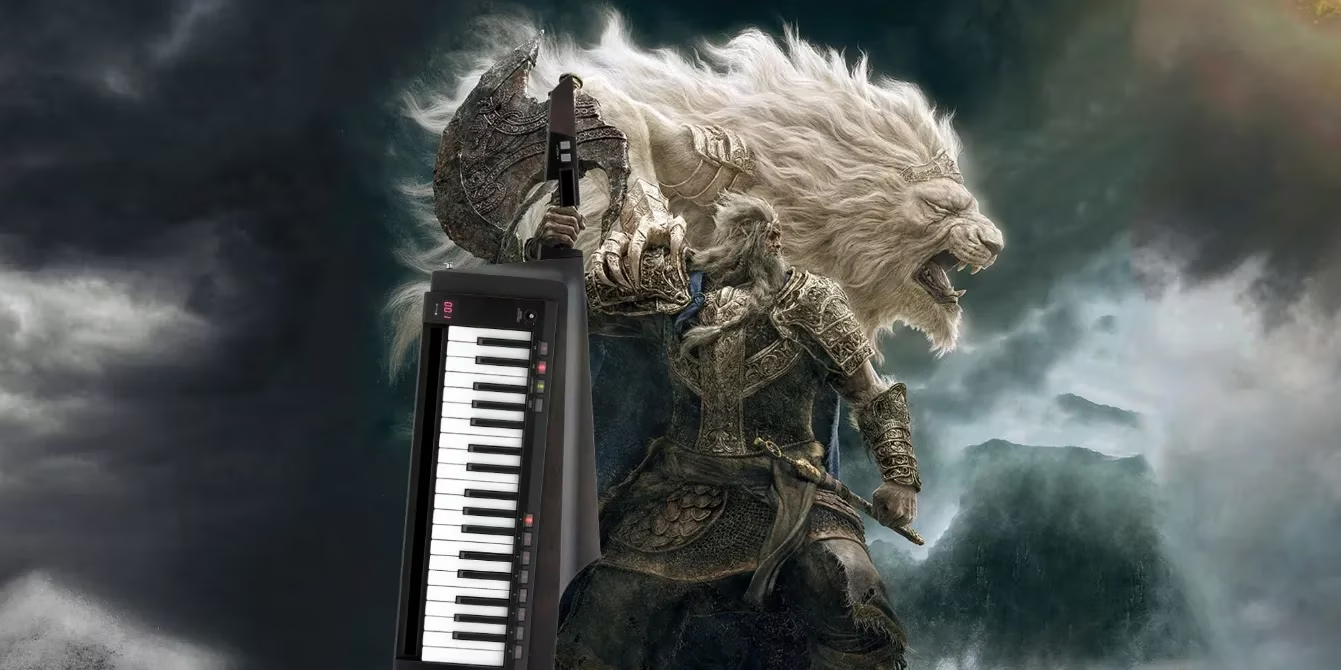
I’ve spent the last few years covering this game’s evolution, and what Omunchkin13 achieved still resonates like a perfect chord. Harnessing a free version of the Bome MIDI Translator, they mapped every fundamental action—rolling, attacking, healing—to a unique musical note. The result was a symphonic playthrough where combat became a performance. According to their original Reddit post, after countless deaths that would make even the most hardened Tarnished weep, every mandatory boss fell, along with the vast majority of optional ones. The final encounter against the Elden Beast wasn’t a mere victory; it was a crescendo, the piano’s melody weaving through the beast’s golden arcs like a ribbon of light threading a needle.
The broader landscape of player creativity has only intensified since the game’s release back in 2022. By 2026, what began as a torrent of mods has matured into a subculture. The seamless co-op mod, once a fledgling project, is now a polished experience that turns every journey through the Lands Between into a shared ballad. Meanwhile, the randomizer mods have become so sophisticated that they essentially shuffle the game’s DNA, ensuring that no two playthroughs ever harmonize the same way. These tools aren’t just gimmicks; they’ve become the anvil on which unconventional controllers are forged. It’s a creative feedback loop—the more malleable the game becomes, the more players seek to interface with it through extraordinary means.
Of course, FromSoftware hasn’t been idle. After Elden Ring became the best-selling title of its year, the studio delivered the Shadow of the Erdtree expansion in late 2024, a DLC that many critics and I agree rivals the base game’s finest moments. New areas like the Scorched Steppe and bosses such as the enigmatic Mirror-Saint Loretta gave these alternative-controller virtuosos a whole new set of challenges. Within weeks of the DLC’s launch, updated MIDI mapping profiles flooded forums, and Omunchkin13 returned to social media with a cryptic promise of a “requiem” for the new content. It didn’t surprise me when, early in 2025, a video surfaced of them flawlessly parrying the DLC’s final boss with a descending minor scale. The legacy persists.
What fascinates me most is how this trend has rippled through FromSoftware’s philosophy. When Dark Souls 3 received the Ringed City expansion, it felt like a final bow. With Elden Ring, the relentless community has turned every piece of content into a new movement of an unending composition. Speedrunners have since combined the piano method with glitch exploits, breaking sub-five-minute world records that seem to exist in a dimension beyond my grasp. A recent charity event even featured a full orchestra, each section controlling a different player in a co-op run—a literal ensemble cast.
The electric piano victory was never just about difficulty. It illustrated that Elden Ring’s skeleton—its input buffer, its generous key-binding, its rhythmic combat—is a lyrical framework ready to be conducted. For me, witnessing this has transformed how I play. I now see the game’s punishing bosses not as walls but as duets, where every death teaches a new measure of the song. And when I think about the future, I suspect the next frontier won’t just be new instruments, but entirely new sensory inputs. Until then, I’ll keep my controller close and my keyboard closer, marveling at a community that turned a medley of notes into a throne.