
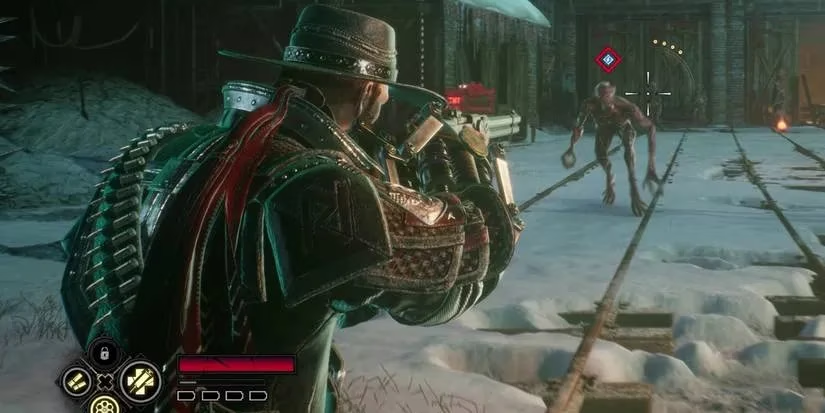
It’s 2026, and I’ve just finished a playthrough of Evil West—that gloriously PS2-DMC-style wild west vampire basher—and I’m looking at my character sheet with a mix of regret and bemusement. I stuffed so many hard-earned perk points into the flamethrower that by the time the lightning gauntlet and the boomstick upgrades arrived, my once-beloved fiery friend had all the menace of a damp whoopee cushion. I lugged that sad metal canister through the entire back half of the game, watching my precious points stagnate like forgotten leftovers. And then, like a divine electric jolt, the game offered me something I’ve come to adore: the ability to respec, to strip my character down to a blank slate and reallocate every single point as if the last ten hours of panicked ability-spamming never happened.
This wasn’t an anomaly. These days, the respec feature has slithered its way into so many genres that I barely blink when I see a ‘reset skills’ button. Borderlands with its infinite customisation stations, Divinity: Original Sin 2 with that magical mirror on the Lady Vengeance, and yes, even the eternally punishing Elden Ring—where the moon queen Rennala lets you sip larval tears to reorder your very soul. But the deeper I dive into this trend, the more I wonder: is total freedom to respec a glorious modern mercy, or does it nibble away at the wonderful agony of commitment? Should we be forced to live with the consequences of our noobish choices, or should every skill tree come with a giant ‘UNDO’ sign? And if we do get that undo button, how dearly should we have to pay for it?
The case for pressing the cosmic reset button
Unless you’re one of those majestic creatures who pre-plans a build using fifteen spreadsheets and a calculus textbook, most of us stumble into RPGs and progression systems utterly blind. We can’t possibly anticipate that the sparkly fireball skill we fell in love with at level three will be completely outclassed by a passive aura we unlock at level thirty. This is exactly what happened to me in Evil West. The flamethrower felt like a monster-melting beast early on, so I pumped it full of perks, only to discover that the game’s later arsenals turn it into a glorified paperweight. I had already put in the work—the sweat of dodging vampire claws—to earn those points. Shouldn’t I have the right to move them into something useful? In a game where you’re a grizzled cowboy punching vampires with an electrically charged gauntlet, the answer is a thunderous yes. The whole point is stupid, chaotic fun, and a respec option lets you stay in that joyous lane without feeling like the game is punishing you for experimenting too early.
This isn’t just about convenience; it’s about respecting the player’s time. In a 2026 where backlogs stretch into the triple digits and every game demands fifty hours of your attention, being locked into a bad build can feel less like a lesson and more like a prison sentence. Respec options let you course-correct without trashing a forty-hour save file. They also encourage experimentation. When I know I can rollback a terrible choice, I’m far more likely to try that weird poison/telepathy hybrid or invest in a ‘charm scarecrow’ skill just to see what happens. And sometimes, those goofy experiments become the highlight of my entire playthrough.
The romance of living with your mistakes
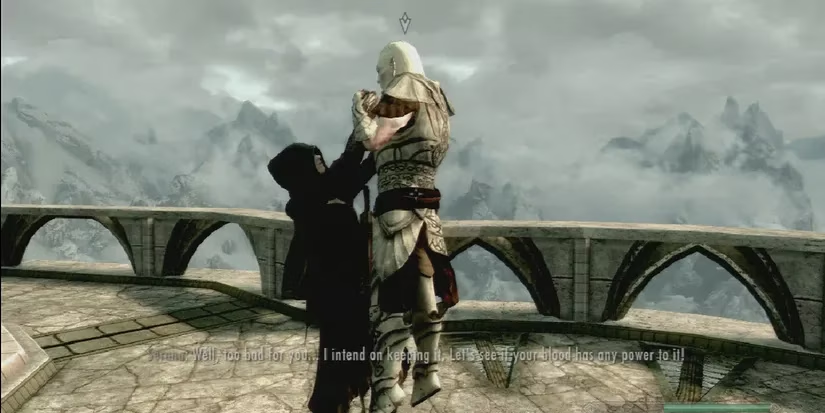
But then I slip into the worn leather boots of a Skyrim adventurer, and I start to understand the other side. Bethesda’s RPGs—Skyrim, Fallout 4, and their kin—have stubbornly resisted full respec for years (outside of mods or a post-game pseudo-reset in Fallout 76). In these sprawling, simulated worlds, your character’s strengths and weaknesses become something like a fingerprint. You didn’t pick the Ladykiller perk? Fine, you’ll charm your way through Whiterun some other way. That wasted point in lockpicking? Maybe you’ll find a key, or just bash the chest open and damn the consequences. There’s a strange, organic beauty to rolling with the punches, letting your playthrough evolve into a story shaped partly by your ineptitude. For me, at least, the lack of an easy respec in these titles keeps me from falling down the min-maxing rabbit hole. I don’t want to turn my Dragonborn into a spreadsheet; I want him to be a slightly incompetent cat-burglar who occasionally eats twenty cheese wheels mid-battle. That’s immersion.
Cyberpunk 2077 pushed this philosophy to a beautiful extreme. Before the 2.0 update, you could only reset perk points, not attribute points, and only at a steep cost. Even now, after the overhaul, a full attribute reset requires a specific rare item from certain ripperdocs, and you can’t do it willy-nilly. The idea is that V’s body is cyberware-laced, sure, but your fundamental aptitudes—your cool, your reflexes—are harder to rewire than a smartgun. This forced me to commit. I didn’t obsess over whether my tech-sniper build was “optimal”; I just lived with the fact that I couldn’t hack a pedestrian crossing without someone else’s help. And that restriction gave my V personality.
The Elden Lord test: earning your do-over
Then there’s the Elden Ring approach, which sits somewhere between brutal permanence and generous freedom. FromSoftware has been slipping respec options into its games since Dark Souls II, but they’ve always made you bleed for it. In the Lands Between, you need to track down Queen Rennala, the once-grand sorceress of the Academy, and offer her a Larval Tear—a glistening, one-use consumable that’s rarer than a smile in Caelid. My first character was a Dexterity-Intelligence hybrid that I envisioned as a lightning-fast dual-katana wizard. By the time I reached the Mountaintops of the Giants, I realised my damage output was about as terrifying as a soggy piece of bread. My katana swings tickled bosses, and my spells fizzled out faster than my enthusiasm. Without Rennala and her tear-driven mercy, I would never have seen the credits. I respecced into a straightforward quality build, and the game suddenly felt… playable. But a part of me ached. I had to abandon my Vision™ and conform to a more conventional build just to survive. Still, the fact that those tears are limited—and that you have to physically travel to Rennala each time—makes the decision weightier than it is in, say, Diablo IV, where you can swap whole skill trees for a handful of gold in every town hub.
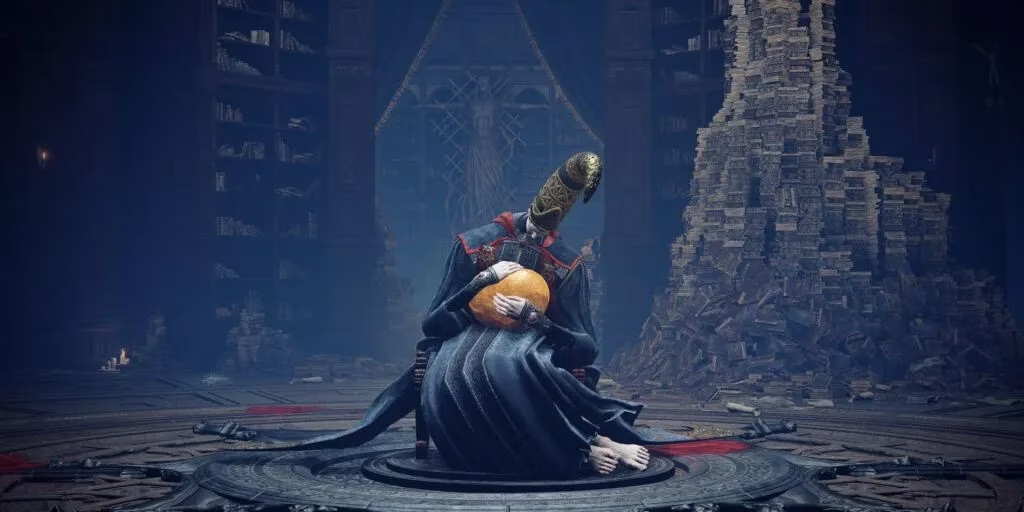
This limited-resource model feels the most elegant to me. It says, “Yes, you idiot, we knew you’d mess up. Here’s your do-over, but you’re going to have to find it, fight for it, and hoard it. Every respec is a narrative beat, not a menu click.” It turns the act of rebuilding into a mini-quest, and that integrates beautifully with Elden Ring’s philosophy of earning everything through struggle. On the other end of the spectrum lies The Witcher 3, where 1000 Crowns buys you a Clearance Potion from certain merchants, instantly refunding all your ability points. It’s practical, but it feels a bit like ordering a stat-reset pizza. There’s no ceremony, no weight—just a transaction. Fine for busy Witchers, but a little too frictionless for my taste.
Modern 2026 titles have mostly embraced the middle ground. Baldur’s Gate 3—still in heavy rotation on my hard drive—lets you respec any character for 100 gold pieces by talking to a kindly undead man in camp. That’s pocket change after your first goblin raid, but the cost still acts as a gentle nudge: “Are you sure, Tav?” The game wants you to experiment with wild multiclass combos, yet it faintly discourages respec-scumming before every single encounter. Meanwhile, Starfield, Bethesda’s latest sprawling epic, finally introduced a respec terminal in major cities, but only after you’ve cleared a faction questline. It’s a compromise that keeps the roleplaying intact while acknowledging that even hardened explorers sometimes wish they hadn’t put four points into Gastronomy.
Where do we go from here?
Honestly, I can’t think of a single good reason why any game with a complex web of upgrades and abilities shouldn’t offer some form of respec. The question is entirely about cost and friction. In a knowingly silly game like Evil West or a loot-shower like Borderlands, let us respec freely; we’re here for the spectacle, not the spreadsheet. In an immersive RPG, make us earn it—through rare items, hidden NPCs, or at least a mildly embarrassing side quest that forces us to admit we’re indecisive adventurers. The more a game asks us to invest in our character’s identity, the more meaningful a respec should feel. A giant ‘RESPEC’ button in the pause menu might be efficient, but it risks turning every character into a formless blob of optimal numbers.
The trend is clear, and 2026 has only solidified it. Players expect the grace to recover from early-game blunders, especially as titles grow longer and more mechanically dense. Yet I hope developers keep treating respec as a design choice rather than an obligatory checkbox. Give me the option, but wrap it in a little world-building, a dash of pain, or at least an NPC who mocks me for my past mistakes. Because that’s what roleplaying is all about—making choices, sometimes terrible ones, and then living with them, growing from them, or paying a witch some pocket money to pretend they never happened. And honestly, after that whole flamethrower debacle, I need all the pretending I can get.