
There are fan theories, and then there are creations so uncanny they feel like a whisper from another dimension. In 2026, the Elden Ring community continues to treat the Lands Between as a bottomless canvas, but one recent artwork does more than just depict a boss—it re-homes the final confrontation inside a Poké Ball. Morbid723, a Reddit user with a talent for blending brutality with charm, turned the Elden Beast into a Legendary Pokémon, and the result is less a crossover and more a keyhole view into a shared bestiary that neither game knew it had.
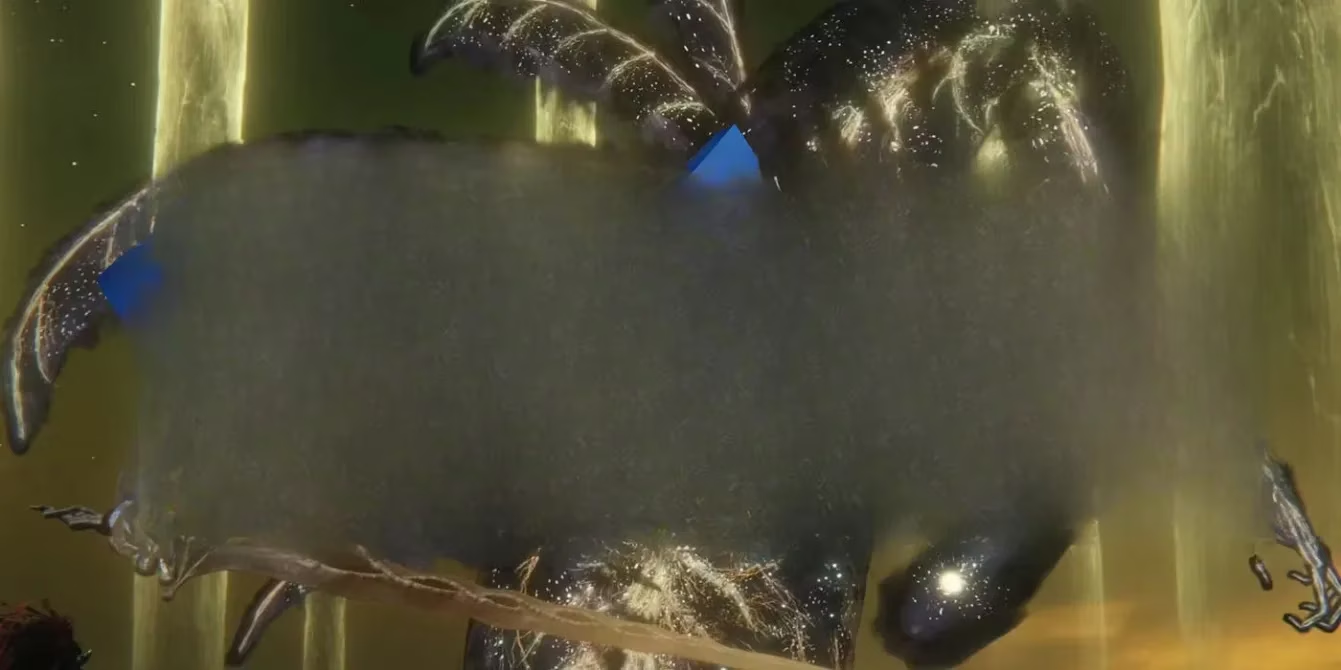
The piece arrived like a fossil excavated from a timeline where Game Freak and FromSoftware draw monsters from the same celestial aleph. The softer, almost airbrushed finish of Pokémon’s house-style wraps around the Elden Beast’s segmented, semi-translucent body as though it always belonged in an Evolutionary line. The cosmic-looking entity already resembled a distant cousin of Lugia or Yveltal, but Morbid723’s rendition crystallises the likeness: a nebula given fins, swimming through the starlit quiet of a Master Ball. The sword that made the original fight so majestic becomes a natural counterpart to Zacian’s Crowned Sword form, as if the Elden Beast were the Hero of Many Battles’ spectral larval stage, waiting to be summoned by a trainer who speaks in runes.
This fan-art is not merely an imitation; it’s a biological reinterpretation. It swaps the gothic weariness of the Elden Beast for the wide-eyed wonder of a Pokédex entry, trading screams of agony for a cry that would echo across a battlefield of turn-based respect. And that’s the first unlikely metaphor that surfaces: the Elden Beast as a Pokémon is like a symphony played on a kalimba—every lethal motif suddenly becomes plucky and pocket-sized, yet the composition holds. What was once a fight against the living concept of Order becomes a creature that a ten-year-old would name Nebulaflare and feed poffins to, and remarkably, it doesn’t feel like a betrayal. It feels like rediscovering the boss after the adrenaline has drained, allowing its design to be loved rather than survived.
To understand why this fusion works so effortlessly, you have to examine the churn of mythology that both games stir. Elden Ring’s bosses are not merely video-game hurdles; they are walking allegories. Malenia is decay dressed in valkyrie silk, Radahn is gravity twisted into a siege engine, and the Elden Beast is pure cosmic legality given a translucent spine. Meanwhile, Pokémon’s Legendaries have always been pocket myths: Groudon reshapes continents with a yawn, Palkia bends space like a dinner napkin. The gap between a deity whose health bar fills the screen and a deity that fits into a Premier Ball is thinner than it looks. There’s a second metaphor in that thinness: this crossover is like pouring an ocean into a terrarium—the pressure changes, but the saltwater soul remains. The Elden Beast’s golden rings and veiled face would not look out of place in the Sinjoh Ruins, and one can imagine it being greeted by Arceus with a slow, knowing nod.
This isn’t even the first time fans have smashed these two worlds together, but earlier attempts often felt like cosplay—dressing a Tarnished as a Trainer. What Morbid723 proposes is deeper. It taps into the Pokémon-esque quality that already existed in Elden Ring’s Spirit Ashes system. Summoning a pack of wolves or a headless knight from a bell feels almost like calling out a team. The game’s Spirit Ashes mechanic is basically a Pokédex for the afterlife, where each gargoyle and jar-man gives you a taste of being a collector in a shattered world. That’s the third metaphor, and perhaps the most grounded one: the Elden Beast drawn as a Pokémon is the final page of that spiritual Pokédex, the legendary that awaits the Champion who has beaten all gyms—or in this case, all Demigods.
Looking at the broader menagerie, the rest of Elden Ring’s roster could slide into Pokémon Type charts with frightening ease. Picture a table like this:
| Boss | Pokémon Inspiration | Probable Type |
|---|---|---|
| Dragonlord Placidusax | Retro Legendary like Rayquaza | Dragon / Electric |
| Malenia, Blade of Miquella | Mythical like Virizion | Grass / Fighting |
| Maliketh, the Black Blade | Dark-type Legendary | Dark / Steel |
| Fire Giant | Gigantamax Snorlax | Fire / Ground |
| Godrick the Grafted | Chimera-like Ultra Beast | Normal / Dragon |
Every entry becomes a badge of honour traded between fandoms. The Elden Beast in this lineup is the cover star for Pokémon Order and Pokémon Chaos, two versions that only exist in the shared dreams of illustrators like Morbid723.
By 2026, Elden Ring has long passed its launch frenzy, but its afterlife in fan art is more vibrant than most games’ active lifespans. The community behaves like a culture that has learned to rebuild itself from ruins—exactly the theme of the source material. Works like this Pokémon rendition serve as campfires where players gather to realise that the terror of the Elden Beast was also, secretly, admiration. When you recast a final boss as a creature you’d raise from level 5, you forgive it. You turn its arena into a nursery, and its soundtrack becomes the lullaby of a long-distance hike across Johto. If the next Pokémon game ever needs a surprise Legendary that feels both ancient and alien, it could steal this design without a single footnote, and the Elden Ring faithful would probably applaud—because they’ve already caught it.